


Wag & Nap Clear Vision
Wag & Nap Clear Vision
Seven eye nutrients in a fish oil you pour on their dinner. No drops in the eye, no pills to hide, dosed by your dog's weight.
HOW MANY BOTTLES?
Couldn't load pickup availability
What's inside
What's inside
In one full dropper:
Omega-3 DHA + EPA — 120 mg
Lutein — 5 mg
Zeaxanthin — 1 mg
Astaxanthin — 2 mg
Vitamin C — 40 mg
Vitamin E — 10 IU
Zinc — 2 mg
No sugar, no wheat, no artificial colour. If your dog is on a prescription diet, show this list to your vet first.
How to use
How to use
Shake it well, the oils settle. Pour it onto their food, stir it through, walk away. The same meal each day is easiest to remember. Keep it in the fridge once opened and use within 60 days.
Shipping
Shipping
Orders ship within 1-2 business days and delivery usually takes 5–10 business days. You'll get tracking as soon as it ships.

Wag & Nap Clear Vision


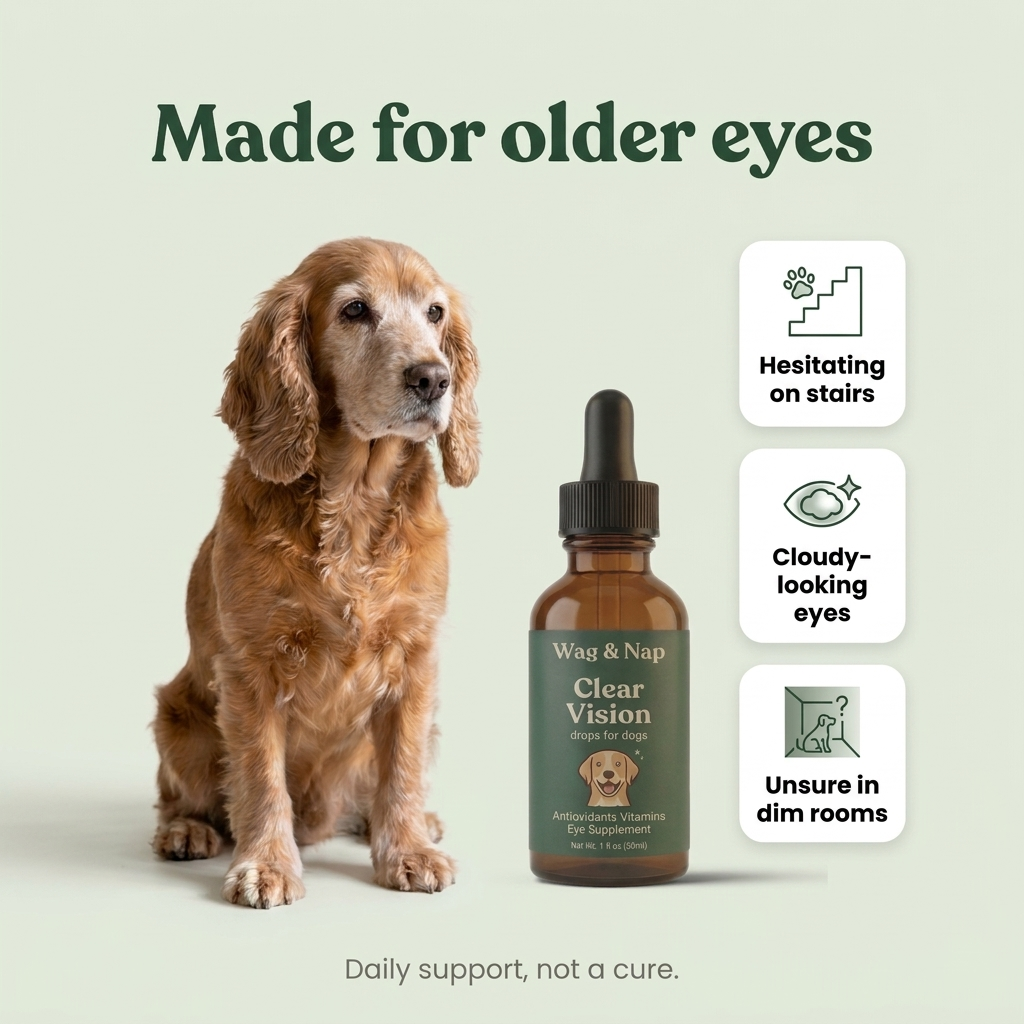
Why is my dog bumping into the couch?
It never starts with a big moment. It starts with small ones you almost talk yourself out of noticing.
He stops at the top of the stairs and waits. She misses the treat you toss her, then finds it with her nose. He barks at you across the yard until you say something. The grey around their eyes gets a little cloudier every year, and because it happens slowly, most of us miss it until the day we can't.
This is a drawing, not a photo of a real dog's sight. But it shows the idea: haze doesn't turn the lights off. It softens edges, washes out colour, and makes a familiar room harder to read, especially in dim light.
Three things that change as a dog gets older
No biology degree needed. Here it is in plain words.
The lens fogs up
Behind the black part of the eye sits a clear lens, like a window. With age it can go milky. Light still gets in, it just arrives blurry. This usually doesn't hurt.
The screen gets thin
The back of the eye is called the retina. It works like a screen. It's built partly from a fat called DHA, and the body has to keep topping that up from food.
Light leaves a mark
Cut an apple, leave it out, it turns brown. Eyes deal with something similar every day from sunlight and normal wear. Scientists call it oxidative stress. Antioxidants are what slow the browning.
So we gave the eye three things to work with
Dinner Drops isn't clever. It's just the stuff the eye actually uses, in amounts we print on the bottle.
Vitamin C, vitamin E and astaxanthin are antioxidants. They're the ones that slow the "browning". Astaxanthin is the red pigment that makes salmon pink, and it's one of the few antioxidants that can reach eye tissue.
The eye stores two yellow pigments, lutein and zeaxanthin, right where light lands. A dog's body can't make them. Every bit has to come from what they eat, and most dog food has very little.
Omega-3 DHA is a building block of the retina itself, not a bonus. We use fish oil so it arrives in the form the body already knows what to do with.
What's in one full dropper
Most pet supplements hide behind the words "blend" or "complex". Here are the numbers.
From wild fish oil. DHA is part of what the retina is physically made of.
From marigold flowers. One of the two pigments the eye stores where light hits hardest.
Lutein's partner. They're almost always found together, so we include both.
From algae. A strong antioxidant that can actually reach the eye.
Everyday antioxidant support, and it helps vitamin E keep working.
Protects the omega-3 fats from going off, inside the bottle and inside the body.
A small amount. The eye uses zinc to move vitamin A around.
No sugar, no wheat, no artificial colour. If your dog is on a prescription diet, show this list to your vet first.

How much does my dog get?
Tap your dog's size. That's the whole instruction.
That's one full dropper, poured over dinner.

Shake the bottle. The oils settle, so give it a proper shake each time.
Squeeze the dropper and pour it straight onto their food. It smells like fish, which most dogs are very happy about.
Stir it through and walk away. Same meal every day is easiest to remember.
Honestly, is this for your dog?
Probably yes if
- ✓Your dog is seven or older and slowing down around stairs, doorways and dim rooms
- ✓You've noticed a light haze and your vet said to keep an eye on it
- ✓You have a breed that tends to get eye trouble early — poodles, huskies, cockers, terriers
- ✓You've tried eye drops and lost that battle
- ✓Your dog is young and you'd rather start early than catch up later
Probably not if
- ✕You want a quick fix. This is daily nutrition, not a treatment
- ✕Something changed this week. Get it looked at first
- ✕Your dog already gets a fish oil and a full eye formula. You'd be doubling up
- ✕You want a cloudy eye to look clear. That is not what this does
- ✕Your dog is pregnant, nursing, or on medication — talk to your vet before you add anything

Next to the other options
How the daily routine actually compares.
| Dinner Drops | Eye drops | Chews & powders | |
|---|---|---|---|
| No holding their head still | Yes | No | Yes |
| Amount of each nutrient printed | Yes | Rarely | Sometimes |
| Dose changes with your dog's weight | Yes | No | Sometimes |
| Works if your dog spits out pills | Yes | Yes | No |
| Cost over a year | Low | Low | Low |
What owners tell us
The change people mention most isn't the eyes. It's the stairs, and it often comes up in the first few weeks.

Murphy is eleven and had started waiting at the bottom of the stairs for me to come and get him. By the end of the first month he was going up on his own again. I can't tell you his eyes look different. But that change I'll take.
Dana W.Murphy, 11, beagle mix — 5 weeks in

Bought it for the simple reason that I could never get drops into this dog. It goes on her dinner, she licks the bowl, done. Whether it's helping her eyes I honestly can't prove. It's helping my mornings.
Peter L.Nala, 9, border collie — 3 weeks in

A few weeks in and he seems a bit more willing in the garden at dusk. The cloudiness looks the same to me, so I'm marking it four stars rather than five. Our vet was fine with the ingredient list, so we're staying on it.
Alice M.Bruno, 13, cocker spaniel — 7 weeks in
These are individual experiences, not typical results, and not a promise about your dog.

Checked before it was sold
I get asked about eye supplements constantly, and my honest answer is that they are support, not treatment. What I look for is whether a company tells you the amount of each nutrient and whether it tells owners when to come and see me instead. This one does both.
Questions people actually ask
You're not too late to support the eye. You may be too late to change what's already there. Those are two different things, and we'd rather say so.
If the cloudiness came on slowly over a year or two, this is a reasonable thing to add. If it appeared in the last month, get it checked first.
No. It goes on the food. That's the whole point of it. Nothing goes near their face.
Plenty of owners tell us they notice something in the first few weeks. Watch behaviour, not eyeballs. Does he try the stairs without stopping? Does she find the ball on the first go? That's where a change shows up first.
Write the date on the bottle when you open it. It's easy to forget how things were a month ago. Every dog is different, so give it the full bottle before you decide.
Ask your vet before adding it. That's not us being careful for legal reasons — fish oil genuinely interacts with some medicines, blood thinners in particular. Show them the ingredient list above. It takes them ten seconds to read.
Nearly all do. It smells of fish, which for a dog is a selling point. If yours is fussy, start at half the dose for a week and mix it well into wet food.
Same bottle, same dose by weight. Plenty of owners start at three or four for the same reason people take care of their teeth before anything hurts. Nothing here is only for old dogs.
Fridge after opening, cap on tight, and use it within 60 days. It's fish oil, and fish oil goes off. If it ever smells sharp or paint-like instead of fishy, bin it and email us.
money back
Use the whole bottle. Then decide.
An unopened bottle tells you nothing. So finish it, take the time it needs, and if you don't think it did a thing for your dog, email us and we'll refund you. You don't have to send the empty bottle back.
Start your dog on Dinner Drops